Shirpur Education Society's
R. C. Patel Institute of Technology, Shirpur
An Autonomous Institute
Affiliated to DBATU, Lonere (M.S.),
Approved By AICTE, New Delhi and Govt. of Maharashtra (DTE: EN - 5172),
Accredited by NAAC 'A' Grade, Bangalore.

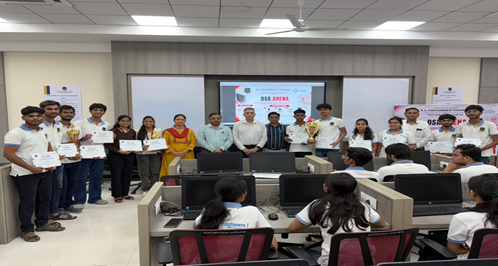
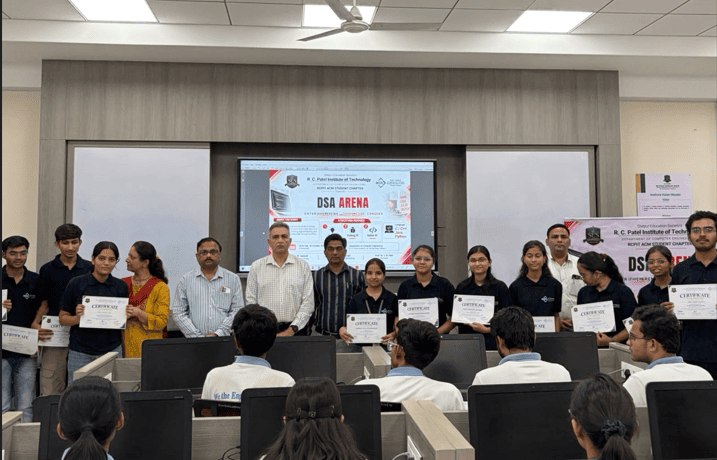
DSA ARENA HACKATHON
To promote Data Structures and Algorithms (DSA) among students and give them a competitive platform to develop their problem-solving, debugging and coding skills in C, C++, Java and Python. The activity also aims to encourage logical thinking, healthy competition and confidence in solving real programming problems. It also brings students from different colleges together in one technical event.
The competition was held in three rounds:
- Round 1 – Quiz It!
The first round tested the participants’ conceptual knowledge of Data Structures and Algorithms. Teams answered questions on core topics such as arrays, linked lists, stacks, queues, trees, graphs, searching, sorting and the time and space complexity of algorithms. The questions were 30 and the round lasted 50 Minutes. The round checked whether participants understood the fundamentals before moving on to coding, and it tested accuracy and speed of thinking. Teams were shortlisted for the next round on the basis of their scores in this round.
- Round 2 – Debug It!
The second round tested the participants’ ability to read code and find mistakes in it. Teams received programs containing errors and had to find and fix them. The programs were in C, C++, Java and Python, and participants could work in the language they were most comfortable with. The errors could be syntax errors, logical errors or wrong outputs caused by faulty conditions, loops or data structure operations. The round was for 50 Minutes and had 08 quetions. This round tested code-reading and analytical skills, attention to detail and a clear understanding of how programs behave, which are skills needed in real software development.
- Round 3 – Solve It!
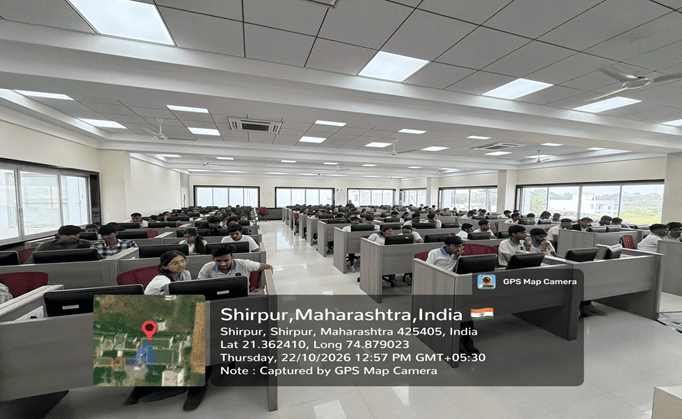
The final round was a problem-solving round held on the CodeChef platform. Teams solved programming problems based on Data Structures and Algorithms, writing complete solutions in C, C++, Java or Python. The solutions were checked against test cases on the platform, so they had to be correct and efficient. There were 10 problems and the round lasted 01 Hour. Teams were ranked on number of test cases passed and problem solved. This round tested logical thinking, algorithm design and coding speed, and it gave students experience of a real competitive programming contest. The final rankings were decided on the basis of the results of this round.